Showing posts with label Gaming. Show all posts

Saturday, 11 August 2012

A Piece of the Pie


I’ve recently been giving thought to an old television series from the 1990s, that I used to watch when I came home from school. It was a 3D computer generated animation series from Canada (/UK) called 'Reboot', and took place in a computer world similar in concept to 'Tron'. The reason it had sprung to mind is because I occasionally check to see if the series has been released on DVD, and despite the late one-off specials it has yet to make its way here in the UK.

I’m eager to revisit the series as I found numerous aspects of it quite inspired, and I have sometimes found myself wondering if it has had an influence on various kinds of media released since which bare some striking similarities. It is just one of these similarities which led me to this post, and of course connects to the video game industry.

It is, as you’ll have already guessed from the image above, based on the main location of 'Reboot'. It is a circular city called "Mainframe" (left image) and it is split into numerous regional sectors, at its center sits the main hub of the city where all of the dignitaries reside. It bares a strong similarity to "Midgar", a location that features in the subsequently released Japanese video game 'Final Fantasy VII', in which the (also circular) city is likewise split into numerous sectors and named accordingly.

This made me wonder if 'Reboot' had been a source of inspiration for 'Final Fantasy VII', it is just one of a few potential similarities that could suggest so. Another such comparable instance based on those cities is a major event that effects them both. Early in the 'Reboot' storyline there is a device known as the "Gateway Command", this is hijacked by the antagonist of the show who subsequently causes it to explode. This results in part of the city being completely destroyed.

Similarly, early in the 'Final Fantasy VII' storyline, the antagonists hijack a device which causes a large stone pillar to explode. This pillar holds up a roof above the Sector 7 slums and results in the complete destruction of that region.

As with anything these could simply be coincidentally similar, but if it turned out that this series was in fact an inspiration for the project then it certainly would say a lot about the legacy of 'Reboot'. Especially when you consider the success and sheer number of fans that 'Final Fantasy VII' commands.

Thursday, 9 August 2012

R-type Delta and the Total Recall link


There is an issue with 'R-Type Delta', which doesn’t often come up in conversation when the game is mentioned. And despite it being a great title with interesting experiments into both the visual and audio aspects of it, the issue continues to baffle me to this day. A matter which concerns only a few brief seconds.

The issue in question is with regards to the piece of music that plays during the character (or rather, ship) selection screen, it holds a strong similarity to the opening theme of the movie 'Total Recall'. There is nothing wrong with similarities and inspired pieces, but when you listen to both of the above tracks together you begin realise that it is not merely influenced.

The soundtrack to 'R-Type Delta' was great, so I wouldn’t generally say that they had stolen the theme….they didn’t need to. But then, it seems too random and out of place with everything else to be considered a direct reference to the film.

So what was the thinking behind this track I wonder?

As a side note: whenever I play 'R-Type Delta', I am never reminded of 'Total Recall'. However, whenever I watch 'Total Recall' I am always reminded of 'R-Type Delta'.

Now where is the justice in that.

Sunday, 5 August 2012

Snare


Although this game is considered one of the weaker titles by Thalamus, something always made it feel a bit grand to me. I always got a certain feeling from the game that made it seem almost fearful, perhaps the futuristic setting mixed with my own imagination as a child gave it a certain finality.

Martin Walker’s music for the game certainly inspired these notions, and the sweeping tones gave it a certain eerie mood. The loading screen music which led into the game’s main title was, I think, for me even more inspirational than the game itself.

The game (made by Rob Stevens) was a sort of derivative of the light cycle bike game from the movie 'Tron', whereby you would guide a spaceship through various levels whilst avoiding certain traps and obstacles.

In each level there would also be a number of rival spaceships whose aim it was to take you out, and with the ability to leave a solid wall trail behind you it was a matter of tactics to try and use your walls to eliminate the enemies before they used theirs on you.

Without Walker’s soundscape the vision of the game would have been a lot less impressive to imagine, but what was delivered was definately of its age. If this had been a more recent release without the tones of the C64 sound set, I don’t think it would have been as emotive. It stands as a great example of what was achieveable with the limited sounds that were at a music programmer’s disposal.

Friday, 3 August 2012

The unforgetable themes of Steve Barrett


Perhaps one of the most iconic tracks from my childhood would have to be the main theme from 'Magicland Dizzy' (or if you prefer, ‘Dizzy 4’) by Steve Barrett. It was suitably bouncy and had a good steady pace to it, which remained with you for the duration of the game. [skip to 2:07 in the video]

Being the time-consuming adventure game that it was, the repetitiveness of the music could often swing the balance between being a motivator to carry on with the game in times of frustration. Alternatively, the umpteenth playthrough of the music loop could also at times heighten the frustration and lead you straight to the ‘off’ switch.


Of course, the success of the game itself is what makes the music so memorable, if a game is good enough for you to be spending hours playing it then the music is naturally going to stick in your mind. However, there is an additional factor that makes this particular collection of music so memorable.

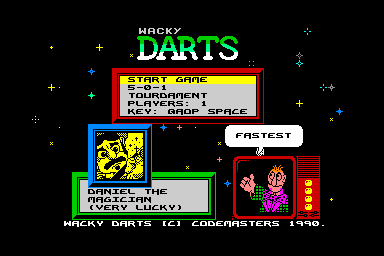
All of Steve Barrett’s music for 'Magicland Dizzy' was also used as the accompaniment for another game by CodeMasters, this being 'Wacky Darts'.

I spent almost as much time playing each of these games as they were both equally brilliant titles in their respective genres, and so it becomes obvious why Barrett’s music has remained a classic in my memory at least.

I’m sure that those who remember 'Wacky Darts' will share nostalgia of their losses at the hands of CPU player "The Magician", who was almost literally unbeatable. He didn’t even use darts, he fired lightning bolts from his hands. I mean come on….who does that?!


This duplication of Steve Barret’s music for two separate games occured on an earlier occasion, again making it all the more memorable to people who had experienced both of them.

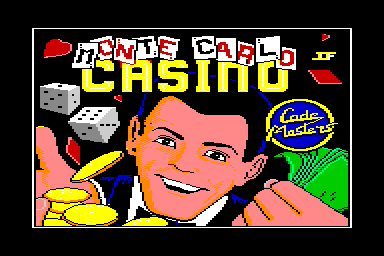
The year prior to the release of the two previously mentioned games saw a title known as 'Monte Carlo Casino', pretty self explanitory of what kind of game it was. This had more of a TV game show feel about it with regards to the music, with cues at the beginning of each round and also when you’d ran out of cash (ie. Game Over!).

Regardless, the music for this game was used again for a separate title called 'Pub Trivia'. Naturally, because of the TV game show vibe the music had, this worked out to be a good choice here as well.

These were another two games that were both enjoyable, perhaps more so the latter which even my own mother played for many hours.

In conclusion, all of these gaming experiences meant that I heard a lot of Steve Barrett’s music around this time. We’re talking a matter of about 3 or 4 short tracks, only a very small part of game music history. But by no means any less important.


Wednesday, 1 August 2012

CJ's Elephant Antics


This was one of the games from my childhood that made the most impact. It was a platformer about a young elephant who had to make his way through Europe and back to his family in Africa. CJ had been captured with the threat of becoming a zoo exhibit, but due to complications with the plane transporting him he was able to escape. Landing in France; he makes his long journey back home.

'CJ’s Elephant Antics' had strong gameplay for a platformer and I remember playing it numerous times because of how much I enjoyed it. The end of level bosses were great and in particular the first level boss, the hunchback of Notre-Dame, has always stuck in my mind as one of the most iconic bosses of yesteryear.

However, another main reason that this game had such a great impact was due to the music by Ashley Hogg. Over 20 years since it’s release, I find it amazing that the themes from this game still continue to be whistled throughout the house today by older family members who had never even played it. It says a lot about video game music when such early examples are having an effect on external parties.

Despite having only had a short-lived career in the musical side of video games, choosing instead to focus on the programming aspects, I consider Ashley Hogg to be one of my earliest inspirations and one of the more underated video game musicians who could have…perhaps…gone on to compose for bigger and better projects.

I am sure that he would at least find it quite strange to know how much of a presence his music has had in my home over the years.

Saturday, 28 July 2012

DIzzy, Prince of the Yolk Folk


The music for this game, from Alistair Brimble, was for me always more memorable than the game itself. It was one of the better games in the legendary adventures of Dizzy, the greatest (or at least, my favourite) of which shall be the subject of a subsequent post.

Thursday, 26 July 2012

Batman - The Movie


Subsequent to the previous post, I felt that I should say something about another Batman game that I played a lot back in the day; 'Batman - The Movie'.

This was very different in style to that of The Caped Crusader game as it was a clear cut platformer, albeit with the odd driving level here and there. As I recall it didn’t have any music accompaniment (at least, not the ZX Spectrum version which I owned) leaving only the basic sound effects for atmosphere.

The lack of any music did not lessen my enjoyment of the game, in fact at the time it was one of my favourite games to play. Despite the very primitive colour scheme, the gameplay was where the game excelled.

As you moved Batman through the levels, his batarang could be used to grab ledges and move higher up the screen. Although you could also use it to swing across to the other side of the screen. I remember finding this swinging action really enjoyable as it gave the game a kind of complexity that was not often seen in other titles around that time. I don’t know if this was a ridiculously difficult motion to program back in those days, but I thank the programmers for putting in that hard work.

Tuesday, 24 July 2012

Batman - The Caped Crusader


This was an early game that had a visual style different to anything else that I’ve seen to date. It was done in a comic book style whereby each scene was placed within a bubble, and when the character walked off screen the next part of the location would pop up in a new bubble at the forefront. The previous screen would still be visible underneath but at a lower opacity, it was a good shot at a comic book style game.

The music by Fred Gray was also memorable for me, in particular the 4-bar intro. It’s these very small things that led to greater inspiration in subsequent works.